Showing posts with label Saints. Show all posts

Wednesday, December 8, 2010

Intercede for us, Holy Nicholas!

A friend of ours has recently found out that their unborn baby has passed away at just over 12 weeks gestation.  His wife will have surgery today.  If you are inclined to pray for them, the baby's name is Nicholas.  Pray for him and for his Mommy and Daddy.


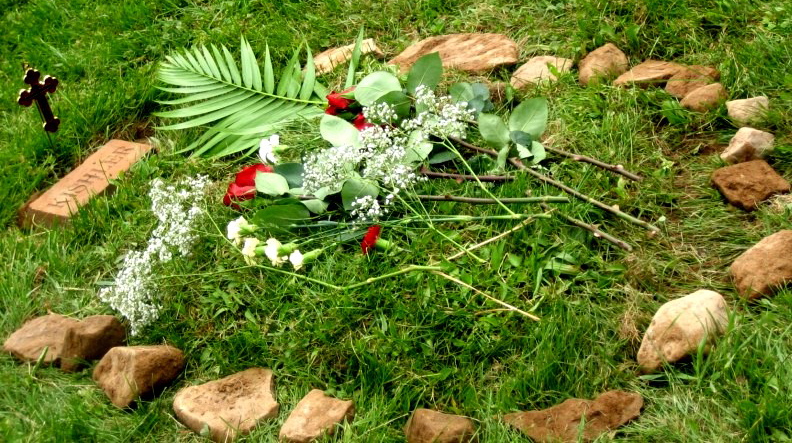
Our Baby Constantine's grave, St. Tikhon's cemetery

I know I am incredibly blessed to have (now) three healthy children here with me.  When we miscarried a couple of years ago, I was comforted by the thought that if I only ever had my two baby girls, that I would still be blessed and happy with our little family.  And as any regular readers know, God continued to bless us with another baby this summer.

But my heart goes out to those families who have to endure the miscarriage or death of their first baby.  To have your innocence shattered by the loss of your first child would be one of the most difficult things I think a parent could go through.  And the questions!  Why didn't my baby live?  Did I do something wrong during my pregnancy?  Will I ever be able to carry a baby to term?  Why wasn't I allowed to meet my little one?  Why me?

Any time I hear of the passing of an unborn baby, I am reminded of what my sweet doctor told me after my own miscarriage.  He mentioned that some women, for every baby they are able to meet in this world, they have several babies praying for them in heaven. How comforting!

It is entirely possible that I, too, have several unborn children in heaven keeping Constantine company.  I have no way of knowing whether we've had just the one miscarriage or if I've had a few very early ones too.  It is possible that I may have more in coming years.

What a heart-swelling thought: All the unborn children I have had or may have in the future are a great cloud of children praying for me, my own personal army of tiny saints, perfected and taken before the temptations of this world.  How we ache to meet them, but how they rejoice with our Lord!


Icon of the children being brought to Christ, located in a rock outcropping at St. Tikhon's Monastery

I thought it especially joyful and appropriate that these parents chose the name Nicholas for their baby.  Of course, the timing is right, being that St. Nicholas's feast day was on Monday.  But don't some of the hymns and prayers to St. Nicholas refer to him as a special friend of children?  Imagine him surrounded by our lost little ones, their heavenly surrogate grandfather praising God with them and leading them in interceding for us.

Holy Saint Nicholas, special friend of children, pray to God for us!

Thursday, December 2, 2010

Kursk Root Icon in Chicago

I was first made dimly aware of this icon by Mat. Anna's recent post in honor of its feast day on November 27.


I say dimly, because I didn't think about it much until a few connections were made in my brain through various people and I realized that this icon is in Chicago.


My husband was planning to attend a Synergy meeting tonight, which happened to be at the ROCOR Holy Virgin Protection Cathedral in Des Plains, which also happens to be the current stop for the Kursk Root icon.


The Synergy group was blessed to be able to view and venerate this holy icon.


Dn. Andrew and two priests spent some time trying to discern the names of the prophets depicted around the Theotokos.   King David and King Solomon are the top left and top right, respectively.  Isaiah, Moses, Habakkuk, Elias, Jeremiah, Daniel, and Gideon are the rest of them, but we don't remember who is who.

Can you believe that this icon is over 800 years old?  And yet this icon is not buried in a museum but is allowed to travel and the faithful are able to venerate it.  What a blessing!

(Thanks to Michele for the last two pictures!)

Thursday, September 23, 2010

Saints by Letter: Week Oo

St Basil of Ostrog
Commemorated April 29


St. Basil (also known as Vasilije) was born and raised in the Popovo region of Herzegovina in the Sixteenth Century.  His devout parents taught their son Basil all about prayer, the Christian faith, and love for Jesus Christ.  When Basil was old enough, he chose to live as a monk.  He moved to the city of Trebinje, where he joined the Monastery of the Dormition of the Theotokos.

Because of his love for the Church and his godly life, St. Basil was chosen to be ordained as a bishop.  He led the Church during an extremely difficult time of attacks from the Turkish Muslims and disagreements with Roman Catholic Christians.  Even during this hard time, St. Basil was a humble man who prayed, fasted, and did other things for God and the Church.  As a bishop, he lived at the Monastery of Tvrdog until it was destroyed by the Turks.  After that, St. Basil moved to Ostrog, where he continued to preach and teach the Orthodox faith unceasingly to his flock.  St. Basil died at Ostrog in 1671, where his tomb remains to this day.

St. Basil’s great love for Christ and His Church did not end at his death.  The Epistle to the Hebrews tells us, “You have come to … the Heavenly Jerusalem, and to innumerable angels in festal gathering, and to the assembly of the first-born who are enrolled in heaven, and to a judge who is God of all, and to the spirits of just men made perfect, and to Jesus” (Hebrews 12.22-24 RSV).  This means that departed saints like St. Basil are always with us as long as we love Christ and continue to gather with His people, the Church.  St. Basil is perhaps best known for the miracles he performed after his earthly life had ended!

St. Basil’s body in his tomb at Ostrog, called relics, continue to work wonders.  Each year on the Feast of Pentecost, when the Holy Spirit came down to the Apostles in the upper room, pilgrims gather at Ostrog to pray at the tomb of a man who was filled with the grace of the same Holy Spirit in life and in death.

St. Nikolai Velimirovic tells us a story about a healing performed by St. Basil:
“One recalcitrant young man, who ridiculed God and his parents, suddenly went insane. The entire city in which this young man lived saw, in this, the punishment of God and was terrified with the fear of God. The young man was held bound and isolated for three years. His mother wept bitterly and prayed to God for her son. One year, during the Feast of Pentecost, the mother brought her insane son to the monastery of St. Basil in Ostrog. After prayers, the insane youth was cured and became himself again. After that, he became an exemplary person and a true Christian.” (from the Prolog of Ochrid)
St. Basil also healed a United States Senator from Illinois.  Senator William Bar was almost killed on June 2, 1970, when an unknown criminal strapped dynamite to the bottom of his car.  Senator Bar survived the explosion, but needed to have his right leg removed.  He lived in great pain and constant sickness because of this.  Doctors tried to heal him from this illness but nothing worked.

However, one night the Senator had a strange dream about a white church built into the side of a giant mountain.  He had this dream repeatedly, night after night.  He would visit this white church and in it, he would witness an old man with a long white beard walking around and healing many sick people simply by touching them.

Senator Bar did not understand this dream, until one day when he went to visit a doctor who could fit him with a prosthetic leg.  He happened to see a picture in a doctor’s office of this same church, next to an icon of the same elderly white haired man from the dream!  The doctor, a Serbian Orthodox Christian, explained to the senator that the white church in the mountain is the Ostrog Monastery, and the white-bearded man is St. Basil of Ostrog.  Senator Bar received the prosthetic leg and could now walk normally, but he was still in much pain.

In 1980, Senator Bar made a pilgrimage to the Ostrog Monastery, along with a group of people who had also lost arms and legs.  He fasted for 40 days and prayed the “Our Father” constantly.  He made a very difficult climb uphill to the monastery, where he was finally able to pray in front of the relics of St. Basil.  Each time he went to the monastery, a little of the pain went away. "I admit, I was a skeptic,” Senator Bar said later.
 “I thought it may be just a superstition. But this is a phenomenon that is impossible outside the Church. I saw blind, deaf, dumb, patients carried on stretchers, children and adults, all climb uphill to the monastery either on foot or in a car. I believe in God's miracles, for I am a witness."
Senator William Bar returned home with no pain, and a much greater faith and love for God in his heart.  He became an Orthodox Christian and devoted the rest of his life to helping other people with missing arms and legs, thanks to being healed by St. Basil of Ostrog.


Troparion to St Basil of Ostrog
Tone 4

From your youth you devoted yourself entirely to the Lord, indulging in prayers, labors and fasting; O father, loyal to God, you were an example of virtue to your flock.  God, therefore seeing your virtuous attitude, appointed you as a shepherd and worthy hierarch of His Church; and after your passing away He preserved your body undecayed, O Saint Basil, and as you have no fear, beseech Christ our God to save our souls!

Copyright © Sibling Revelries 2010
Icon found at www.stbasilchurch.org/about.html 
Troparion found at www.nikolaresanovic.com
Article about Senator Bar at www.johnsanidopoulos.com

Monday, September 13, 2010

Saints by Letter: Week Ii

St. Innocent of Alaska, “Apostle of America”
Feast Day:  March 31

In the First Book of Samuel in the Old Testament (First Kingdoms in the Orthodox Study Bible), we hear about the calling of the Prophet Samuel when he was a young boy serving in the temple.  Three times in the night, Samuel heard a voice calling him, and three times he woke the Priest Eli to ask why he had called.  After the third time, Eli told him that it might be the Lord Himself calling.  Samuel went back to sleep.  He heard the voice the fourth time, “Samuel, Samuel.”  Samuel’s response to the Lord is very important: “Speak, for Your servant hears” (I Kingdoms 3.10).  Samuel responded with an open heart, willing to listen to God and do anything God wanted him to do.

We see this same willingness in the life of St. Innocent of Alaska.  St. Innocent was born in the village Anginsk in the Irkutsk region of Russia, on August 26, 1797.  Originally known as Fr. John Veniaminov, he was a married priest with a son named Innocent, serving and teaching at the Annunciation Church in Irkutsk.  But in the 1820’s, though the guidance of the Holy Spirit, the Church began to realize that it was time to spread the Gospel of Jesus Christ in the land of Alaska.  Bishop Michael of Irkutsk asked for volunteers, and Fr. John, like the Prophet Samuel before him, heard the voice of God and decided to go and preach the Gospel as a missionary to Alaska.  “Blessed be the name of the Lord!” he said, as he accepted the call from God.

In 1823, Fr. John left with his wife, his son, his mother and his brother.  It was a long journey and it took them an entire year to get to Alaska.  And when they arrived, they built and moved into a hut made out of dried mud.  Fr. John was a smart and talented man, who used all of his gifts in the service of God and the Church.  In the 45 years he served in Alaska, Fr. John learned several different languages of the native Alaskan tribes, and even wrote an alphabet for the Aleut language.  He translated the Gospel of St. Matthew and other Orthodox texts, and preached at every opportunity he had.  “Whoever abounds in faith and love,” said Fr. John, “can have mouth and wisdom, and the heart cannot resist their serving it.”  Fr. John built schools and hospitals, and even instructed local doctors on how to administer vaccines and other medicines. 


Fr. John traveled all over Alaska, parts of Canada, and even as far south as San Francisco, California, preaching and teaching the Christian faith as a missionary.  It is estimated that he brought around ten thousand converts to the Orthodox faith through baptism.  In 1838, Fr. John traveled to St. Petersburg in Russia to tell the Russian Church about his missionary work.  Sadly, he received word that his wife had died while he was away.  This prompted him to take monastic vows and accept ordination as a bishop under the name “Bishop Innocent.”  As a bishop, he continued his untiring missionary work among the native peoples in Alaska. 


Then in 1868, Bishop Innocent was chosen to be Metropolitan of Moscow, the most prestigious position in the Russian Orthodox Church.  He no longer traveled as a missionary after this, but the bishop used the authority of his new position to start a Missionary Society in Russia, allowing others to continue his work in Alaska and elsewhere.

St. Innocent fell asleep in Lord on March 31, 1879.  He continues to be a great example for all Orthodox Christians as a lover of the Bible, a preacher and teacher of the Gospel of Jesus Christ, and a missionary who believed that all people on earth need to hear, understand, and accept that Gospel.  


Troparion - Tone 4

O Holy Father Innocent
In obedience to the will of God
You accepted dangers and tribulations
Bringing many peoples to the knowledge of truth.
You showed us the way,
Now by your prayers help lead us into the Kingdom of Heaven.


Copyright © Sibling Revelries 2010
Icon and Troparion found at www.oca.org

Thursday, September 2, 2010

Saints by Letter: Week Ee


St. Elizabeth Fyodorovna, Grand Duchess of Moscow
Feast Day:  July 5


In the Gospel of St. Matthew, our Lord Jesus Christ says that whenever we help poor and sick people, and those in prison, we are really helping Jesus Himself: “Inasmuch as you did it to one of the least of these my brethren, you did it to me” (Matthew 25.40). 

Saint Elizabeth devoted her entire life to serving God and helping other people.  She was born into a German royal family, and became the Grand Duchess of Moscow in Russia when she married the Grand Duke Sergius.  She joined the Holy Orthodox Church after her marriage because she sensed the truth of the Orthodox faith.  It gave her great peace and joy to worship the Father, Son and Holy Spirit in the Russian Orthodox Church. 

Tragically, her husband the Grand Duke was murdered by an assassin in the year 1905.  Grand Duchess Elizabeth was quite sad, but God gave her the strength of and love of Jesus during this difficult time.  It was our Lord Jesus who taught, “Love your enemies, bless those who curse you, do good to those who hate you, and pray for those who spitefully use you and persecute you” (Matthew 5.44).  Showing this love, she visited her husband’s killer in prison. 

“Who are you?” he asked upon meeting her.

“I am his widow,” she replied, “why did you kill him?”

“I did not want to kill you,” he said.  “I saw him several times before when I had the bomb with me, but you were with him and I could not bring myself to touch him.”

“You did not understand that by killing him you were killing me,” she said.  Elizabeth gave him a copy of the Gospel, and urged him to beg God for forgiveness of his horrible sin.  Elizabeth later would say, “My attempt was unsuccessful, but, who knows, perhaps at the last minute he will understand his sin and repent.”

After her husband’s death, Grand Duchess Elizabeth became a nun.  She sold her jewelry and expensive possessions, and devoted her life completely to prayer and serving the poor.  With the money she made from selling all of her things, she started a mission in Moscow called the Martha and Mary Home.  She and a group of nuns fed the poor and helped orphans for many years.  They also opened a hospital and did many other good works of charity. 

In 1917, a radical Communist government seized control of Russia.  The Soviets, as they were called, were extremely cruel and violent, and hated the Royal Family and the Orthodox Church.  Elizabeth, along with other nuns and members of the Royal Family were exiled, moved to a forest, and shoved into an abandoned mineshaft.  But even as St. Elizabeth and her companions sat in the mineshaft, hurt and dying, they could be heard singing hymns from the Church: “We who mystically represent the Cherubim, and sing to the life-giving Trinity the thrice holy hymn, let us now lay aside all earthly care.”  They died on July 5, 1918. 

After her death. St. Elizabeth’s body was found and moved to the Church of St. Mary Magdalene in Jerusalem, a church which St. Elizabeth and her husband helped to build. 

St. Elizabeth teaches us how to follow the words of our Lord Jesus Christ in helping the poor and forgiving everyone who hurts us or does wrong to us.  May her prayers be with us always. 


Troparion - Tone 4
Emulating the Lord's self-abasement on the earth, 
You gave up royal mansions to serve the poor and disdained, 
Overflowing with compassion for the suffering. 
And taking up a martyr's cross, 
In your meekness
You perfected the Savior’s image within yourself, 
Therefore, with Barbara, entreat Him to save us all, O wise Elizabeth.


By Dn. Andrew and Sh. Patricia Kishler
Copyright © Sibling Revelries 2010

Saints by Letter: Week Aa

For our first week (this week), we have used this sweet little book for St. Andrew (as recommended by the LOG reading list).  Week Ee is next!

Friday, May 28, 2010

A Nineteen-Year-Old Martyr from 1996

A friend posted a brief life of Great Martyr Evgeny on her blog and I thought I'd share it.  I wasn't aware of this saint, and his is a particularly inspiring story.  He was only 19!  And he was martyred so recently--in 1996!

Makes our faith seem "relevant," doesn't it?

But more importantly, it makes me think even more about how am I raising my children.  Will they at 19 have the faith to withstand torture and death for Christ?  Of course, no mother wants to think about this possibility for her children, but the other possibility--failing to raise children who would make this choice--is no more heartening.

Great Martyr Evgeny, pray to God for us.
Related Posts Plugin for WordPress, Blogger...